USD
USD 
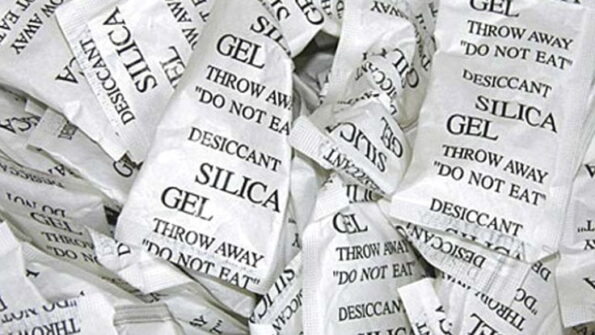
This product, which we encounter quite frequently in our daily lives, is found in small paper packets inside new items such as bags and sneakers. Don't throw them away. You can use them in many places. Our focus, however, is on using silica gel to dry threads that are exposed to damp environments or body fluids.
What is silica gel?
Silica gel is a sodium silicate produced in a laboratory and used in daily life to prevent spoilage of foods, plant products, leather goods, chemical dyes, and most perishable items by absorbing moisture. This substance is patented by Walter A. Patrick, a professor at Johns Hopkins University, in 1919. The substance has a large, sandy structure. It changes color with moisture.
This substance is commonly placed next to medicines to absorb moisture and prevent spoilage; it is also used to preserve many plant-based industrial products and foods. Leather and animal-based items are also protected against decay in this way. The substance changes color by absorbing moisture from its surroundings. It is currently available in various sizes.

Removing Moisture from Our Yarns with Silica Gel
Silica gel is a clean and odorless form of silica dioxide. As a gel, it is relatively hard and typically produced in small beads. Silica gel is highly hygroscopic and an excellent desiccant. The viscous nature of silica gel works by adsorption (holding water on the surface) rather than absorption (drawing water in). Its surface is coated with pores with a diameter of 2.4 nm, making it ideal for desiccation.
A single gram of silica gel has an effective surface area of 800 m². While silica gel is often used to minimize moisture absorption in products prone to moisture absorption, it is also used to balance ambient humidity levels. Silica gel that has absorbed significant amounts of water may change color or crack. To maintain the water-adsorbing properties of silica gel, you need to reactivate it periodically. The frequency of this process varies depending on the amount of moisture and your needs.
Let's prepare our ropes and silica gel.
Let's place our strings inside a cardboard box and, along with the strings, add two packets of silica gel (standard 10g packets or readily available ones) to the box. The silica gel will change color when it reaches its maximum moisture absorption capacity. Until then, let it sit inside the box (preferably in an airtight box with minimal air circulation, or even better, in an airtight box) with the strings. Remember that silica gel will also absorb moisture from the environment. Therefore, this process should be done in an airtight box or, even better, a vacuum-sealed bag.
Reusing Silica Gel
- Don't throw away silica gel after using it. Silica gel can be reused repeatedly. The gel, even if it has changed color, has trapped moisture and can be reused after removing the moisture. How?
- Place the silica gel beads on a baking sheet. Do not allow the beads to touch the metal surface of the baking sheet.
- Heat the silica gel beads at 120°C for 2 hours. The beads must be heated to at least 120°C (248°F) to release any moisture they have absorbed. The beads may be damaged at temperatures above 148°C (300°F).
- Remove the beads from the oven and let them cool.
 Türkçe
 English