USD
USD 
Shibari Rope and Materials
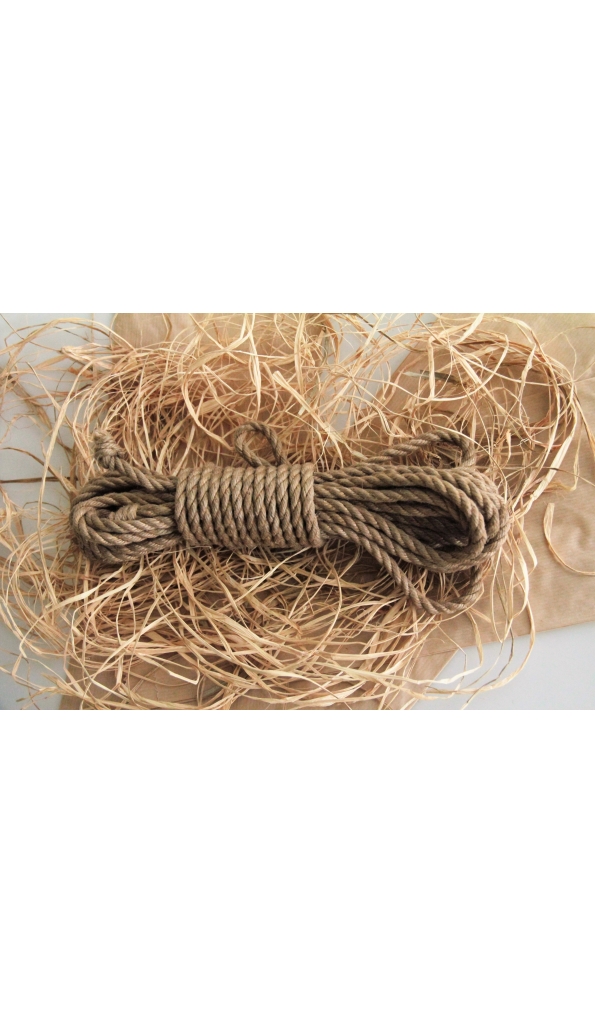
The use of hemp rope is one of the distinguishing features of modern Japanese kinbaku. Hemp rope, with its tight and rigid structure, ensures that the knots are strong and reliable in kinbaku. Furthermore, the nawashi (string) is soft enough to feel the tension of the rope but not flexible, making it resistant to deformation. Many techniques of Japanese kinbaku have been developed based on hemp rope. Natural hemp ropes have also become preferred over jute ropes due to their greater durability. In Europe and America, hemp, and ropes made from hemp fiber, are relatively easy to obtain. In recent years, people have increasingly used hemp rope, which feels more delicate.
However, “hemp rope” is used as a common term – ropes made from fibers of various plant species all look like hemp rope, and the common name hemp is sometimes used for ropes made from natural fibers. In many parts of the world, including our country and within the kinbaku community in Japan, jute is widely used. Jute, Manila Jute, and sisal ropes can be purchased from hardware stores, but their texture is stiff and difficult to soften, and therefore they are not suitable for use in kinbaku. Traditionally preferred, jute rope is considered the most ideal rope for suspension and other types of binding. It is laborious and difficult to wash, dry, and dye. It is susceptible to water and moisture and requires frequent maintenance.
Types of Shibari / Bondage Ropes
Cotton rope has a softer and more flexible texture than hemp rope. Its advantage is that it feels relatively comfortable compared to hemp rope. Its disadvantage is its tendency to stretch and sag under tension. When weight and tension are applied to cotton rope, knots tighten and become difficult to untie. While not recommended for suspension, it can be used if you are a professional and willing to take some risks. It is much easier to wash, dry, and dye. It is often preferred and widely used for erotic bondage.
Nylon ropes are another type of rope commonly used for bondage in Europe and America. Nylon rope has a smoother surface than natural fiber ropes, therefore the knot-forming and rope-attaching techniques differ from those used with hemp rope. Compared to natural fiber, one of the advantages of nylon rope is that water does not harden the rope or damage its texture. Therefore, it is used in water games (water bondage). Shibari It can be used safely in various settings.

Shibari Line Length and Quantity
Modern shibari use rope that is 7.5 to 8 meters (24-26 feet) long, 6 mm (1/4 inch) in diameter, and has 3 wraps (twist or coil). The length of the rope generally varies according to the Bakushi's preferences, model, and individual measurements. In addition to standard lengths, ropes of different lengths and thicknesses can also be used. Increasing the thickness and length of the rope according to body width and weight, using 8mm rope instead of 6mm, would be a more appropriate choice (6mm is recommended for the 45-90 KG range). Below you can find an (average) ideal size chart based on the size of a nawashi and rope bottom (model).

Kinbaku's creative practices stem from its ability to adapt to many different types of bindings without using excessive rope. For example, a commonly used "One Rope" technique is a traditional practice performed with a single rope, revealing the essence of kinbaku. Relatively complex upper body bindings are done with three pieces of rope. Generally, five pieces of rope are sufficient to bind both the upper and lower body. Our habit and recommendation is to use a set of ten pieces, 8 meters long and 6 mm wide. This is sufficient to perform most stage performances.
Where to buy it?
Before purchasing natural fiber ropes, we recommend seeking advice from someone knowledgeable about their suitability and reliability. Avoid buying bondage or other similar ropes from sex shops. Shibari We advise you to avoid products sold under this name, as they are generally of poor quality and sold at very high prices. For those living in Istanbul, we recommend Tahtakale as a first stop; for those outside Istanbul, we suggest hobby supply stores and hardware stores, or you can find a specially prepared product from the ShibariTürk store. Shibari You can buy the rope. Jute, cotton, and nylon ropes are readily available from these sources. Since you can't use jute ropes as soon as you buy them, you must complete a few steps of initial preparation procedures to get the rope ready for use.
Preparing natural fiber ropes for use is absolutely essential because they are rough and stiff. Otherwise, permanent damage to the skin may occur. Processing jute rope involves several laborious and time-consuming steps. Only after these stages can it be processed into a usable product. Shibari Don't forget that it will become valuable and its worth will increase.
Language

Rope Bottom: It is generally used for a partner who is tied up/enslaved. In performance circles, the terms "Rope Model" or "Kinbaku Model" are used. Shibari In Kinbaku, the person bound does not necessarily have to be a slave or submissive. It varies depending on the performance or scene and the nature of the relationship.
Rope Top: In traditional shibari, nawashi is a term that refers to the person who brings together and unites terms like bakushi and rigger in Europe under one umbrella.
Rope head, rope tail: The rope is usually folded in half before use. This increases comfort by widening the area where the rope contacts the body. Therefore, when tying begins, the usable working length of the rope is approximately 3.7 to 4 meters. After being folded in half, the middle section of the rope is called the "rope head" or "bight," and the two ends of the rope are referred to as the "rope tail.".
Collecting and Transporting Shibari Ropes
It's important to neatly gather your ropes after each scene. This is also necessary to prepare them for the next use and to maintain their shape. Of course, there are several ways to gather ropes for transport and storage. Here are 8 of the most common methods. To watch: https://www.youtube.com/watch?v=KcBA9GT4XSs
If you don't plan to move or store your ropes, it's ideal to hang them in a place away from direct sunlight.
Processing and Care of Shibari Yarns
1) You need to cut your raw jute or linen ropes, which you purchased in rolls, into 8-meter lengths. After doing this, the ends of the ropes will unravel due to the windings. To prevent this in the long term, you need to knot and close the rope at the cut points, i.e., at the ends. This is also necessary to add to your rope and ensure comfortable use. Some knots that can be made on the ends of the rope are shown in the picture. For practicality, we recommend the blind knot method, which is used at the beginning.
2) After purchasing, there are a few methods you can use to soften the raw yarn. One is to soften it by boiling, and another is to soften it by abrasion.
Softening by boiling: The boiling method should be determined according to the origin of the rope you are using. Ropes imported from countries like China and the Philippines have stronger windings and therefore stretch less, so this method can be easily used with these types of ropes. For locally produced ropes, an abrasive technique should be used. Prepare a large pot, bring the water to a boil, and then fold the raw rope in half several times to place it inside. The rope should be submerged in the water as much as possible. There are many different opinions on how long the rope should be boiled. Some practitioners recommend boiling for 9-12 hours to remove the petroleum smell from the jute's production process, while others argue that 20-40 minutes is sufficient for softening. We recommend a 40-minute boiling time, as this will be sufficient to soften the rope. After washing, hang your rope to dry using a weight. Drying without a weight will cause the rope to stretch.
Softening by abrasion (Not recommended*): As you will see in the video below, simply secure your string in the middle to a soft, angled surface.
3) After softening your cord, you need to remove any fuzz and frizz. This removes unnecessary fuzz and frizz that can be quite bothersome during the tying stage, prepares your cord for polishing, and eliminates elements that could damage the skin. You can watch this video for this step: https://www.youtube.com/watch?v=hmQg2QcxZwU
After this step, you should gently wipe the cleaned ropes with a slightly damp towel. This is important as it will also remove any soot and dirt that has adhered to the surface.
4) The next step is to oil and polish the rope. This protects not only the rope bottom but also the hands of the rope top. To apply oil or soft wax, it is done by rubbing it onto the surface of the rope in sections of approximately 60 cm to one meter. Oils that can be used include horse oil, baby oil, hemp oil, mink oil, tsubaki oil, coconut oil, jojoba oil, or beeswax. It is not necessary to over-oil the rope. After a few uses, the rope will need to be re-oiled and re-polished. You can watch the process of preparing and oiling a rope, along with the 3 steps above, in the video below.
https://www.youtube.com/watch?v=XPgCL5Oc7lw
Before Kinbaku, it is recommended to wipe the rope once with a clean, damp cloth or leave it in the sun for 30 minutes to ensure hygiene.
Your rope is now ready to use.
Choosing and Comparing Ropes/Cords for Shibari
Although these ropes are generally used according to personal preference, it would be appropriate to compare their advantages and disadvantages in detail in a table. In the table below, explanations in Notes 1-2 are indicated below the table, and those marked with an asterisk (*) are added to the bottom of this page.
Comparison of Materials
 Note 1 : Hırdavatçılardan polipropilen, polyester karışımlı naylon halatlar kolayca bulunabilir. Deniz malzemeleri satan mağazalardan veya yapı marketlerden de temin edilebilir. %100 naylon olmayan karışımlı halatlar boyamada sorun çıkartabilir. Düşük devirde çamaşır makinesinde veya elde yıkanabilir.
- Note 2 It cannot be dyed at home, but it can be dyed during the manufacturing process. There are many color options, and it's almost identical to nylon. It can be washed in a washing machine on a low spin cycle or by hand.
- Note 3 Because it is generally available in natural hemp colors, Hempex is more often preferred among synthetic yarn choices.
- Note 4 The biggest disadvantage of hemp is that the most commonly used Romanian hemp rope (as seen in photos/videos) is made to look thick. You won't get a visually smooth twist. It can also become sticky in humid weather, making it difficult to handle and knot. It can be washed in a washing machine on a low cycle, but drying may require hanging it under a weight. No post-cleaning maintenance is required, but polishing is optional.
- Note 5 The biggest advantage of jute is that it is very lightweight and easily available. Also... bdsm Nawashi sashes are the traditional choice for bondage and suspension. They can be tied and knotted quickly and easily. Washing in a washing machine is not recommended; they can be washed in a dishwasher, but drying may require hanging them on a weight. Depending on their quality, they can be easily damaged when wet. Post-washing and cleaning maintenance (polishing/oiling) is necessary.
- Note 6 You should only choose those with a 3-ply strand, and cotton quality is also an important factor.
- Note 7 It is a type of rope that combines the physical and visual properties of jute and hemp ropes.
- Note 8 It's very hard.
 Note 1 : Hırdavatçılardan polipropilen, polyester karışımlı naylon halatlar kolayca bulunabilir. Deniz malzemeleri satan mağazalardan veya yapı marketlerden de temin edilebilir. %100 naylon olmayan karışımlı halatlar boyamada sorun çıkartabilir. Düşük devirde çamaşır makinesinde veya elde yıkanabilir.
Tips for Suspension Safety
İpe düğüm attığımızda onun kopma kuvvetini etkilediğimizi de göz önünde bulundurmak gerekir. bazen bu kuvvet %60 oranı kadar azalmaktadır. (www.fairex.az)
Ropes are subjected to shear tests by the units that manufacture them. The stress that causes the rope to break is called the shear stress. This stress is used to determine safe working conditions when working with the rope. The safe working load (SAWL) is determined as a certain percentage of the shear stress. This percentage is called the safety factor. For plant ropes, the safety factor is accepted as 6. (http://megep.meb.gov.tr)
Calculation Method for Suspension
An object with a mass of 1.0 kilogram corresponds to exactly 9.81 Newtons on the Earth's surface. The mass of an object is converted to weight by multiplying it by the force of gravity. Newton is the unit of force, while kilogram is the unit of mass. While the mass of an object is the same everywhere, its weight would be lower if measured on Mars instead of Earth due to the weaker gravity there.
Table Notes
*Manila rope is a type of rope made from Manila hemp. Manila hemp is a type of fiber obtained from the leaves of the abaca plant.
**Hempex is a synthetic hemp rope made from spun polypropylene. It is very difficult to distinguish Hempex from real hemp rope.
*** It is hard at first, but becomes softer with use.
Sources;
- https://en.wikibooks.org/wiki/Rope_Making_for_Bondage_Use/Conditioning
- Esinem
- Essence Of Shibari
- https://douglaskentrope.com
- https://bdsmkulturu.com
Extra “How to Prepare Your Own Ropes?”
https://twitter.com/MobyDickAndAhab/status/1513575651693015045
 Türkçe
 English