 USD
USD 
The difference between Shibari and Kinbaku can be examined and explained in many ways. The origins and meanings of the words Shibari and Kinbaku have been debated for a long time. In this article, we have tried to present the similarities and differences between these two words, from their predecessors to contemporary masters, by conveying as much semantic information as possible and through personal opinions.
Basically Shibari Kinbaku, being subjective experiences, can be defined and interpreted differently by individuals. This definition is as subjective as the definition of the rope and the relationship between individuals. On the other hand, there is also a shared, agreed-upon meaning.
Grandmaster Yukimura Haruki (雪村春樹)“For me Shibari, It is an emotional exchange between two people. Shibari, It's about how you use the rope to exchange feelings with someone else. (1) Hajime Kinoko described it as follows:“Kinbaku is about tying people up in BDSM practice and Shibari It's about connecting people, but it's also about connecting something non-human. I think there are more variations of Shibari. (2) shaped Shibari Y. Haruki explains the difference between kinbaku and kinbaku in a statement.“Shibari, He stated that "it is not Kinbaku" and emphasized that the two are different.
In essence, Shibari (縛り) comes from the Japanese verb "to bind" (shibaru; 縛る), which can be used to describe the act of binding or tying things like packages, objects, etc. It is used to describe the act of binding/tying between a nawashi (rope master/artist; 繩氏) and a dorei (model/bottom; 奴隷). (3)
Nawashi Kanna, a prominent figure today, can be seen frequently, though not always, using the word "Kinbaku" in her interviews and conversations.
People who gathered to practice with rope said, "Let's go! Shibari The expression "let's do it" (let's shibari) is used, which is the equivalent of the word "Shibarimashou." "Let's do Kinbaku" (kinbaku o shimashou) is never used. Conversely, the Japanese porn industry prefers to use "Kinbaku" (see: Yukimura Haruki 縛 縄, there is a DVD series).
Etymology
Kanji (漢字, かんじ) are the Japanese names given to Chinese characters. When Chinese characters are adopted into Japanese, they generally have a dual pronunciation: the Chinese pronunciation (On 音, おん) and the pre-existing Japanese pronunciation of the characters' meanings (Kun 訓, くん). These pronunciations are called Kun'yomi and On'yomi.
In Japanese, nouns, adjectives, and verb stems are written using Kanji. Most adverbs are also written in Kanji. Knowing Kanji is necessary to read all words in Japanese writing. However, there are also words that are not written in Kanji. For example, although there is a Kanji for the verb "to be," this word is always written in Hiragana.(4)
When you look at the etymology, both Shibari It is also noticeable that the central kanji in kinbaku is 縛. Like most kanji, it has two different pronunciations. As we explained above, these are On'yomi and Kun'yomi.
The kanji for -Kin in Kinbaku is the same as Kin in Kincho. People use the word Kincho when they want to describe their excitement about a situation (like “I have butterflies in my stomach”). Kinbaku aims to create such a profound sense of sight and emotion that you can hear a needle falling into a deep hole. (5) For this reason, it is also described as "Deep Binding".
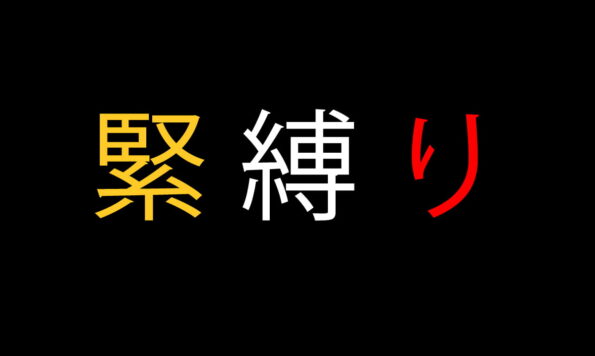
Now let's look at the structure of the words: 縛 can be pronounced as "Baku" in On'yomi pronunciation and "Shibaru" in Kun'yomi pronunciation. Both are derived from the Chinese Hanzi word 縛, meaning "to bind". If you add 緊 (kin) to the beginning, you say "Kin Baku" in On'yomi pronunciation (because these are two kanji). If you add hiragana (り) to the end, Shibari You will encounter it and use the Kun pronunciation (because it is a kanji and a hiragana).
Kinbaku and Shibari, These are two words that share the same root and the same basic kanji. Like all kanji, because they have multiple pronunciations, words based on them can share many of the same meanings, ideas, and cultural conventions.
RESOURCES
- The Beauty of Kinbaku, https://www.kinbakumania.com/en/que-es-shibari-kinbaku/
- http://officemagazine.net/kinbaku-museum-sex
- https://shibaridojobarrie.com/2015/07/18/shibari-versus-kinbaku/
- http://www.guidetojapanese.org/turkish/kanji.html
- https://tokyobound.com/blog/?p=243
 Türkçe
 English


Comments are closed.