USD
USD 
In Shibari, almost any size rope can be used with sufficient creativity. However, for traditional and basic techniques, ropes with a diameter of 5-8mm are generally used. The correct diameter depends on the material of your rope, your partner's measurements, and your tying style. Larger diameter ropes (like 8mm) are generally used for tying wider and larger bodies. A good starting point for beginners is almost always 6mm, and this is generally the most popular size.
Some ropes have a braided sheath wrapped around a flat fiber core. Ropes made for climbing often have the same construction. Clothesline and other inexpensive hardware store ropes are also frequently of the same type. In general, ropes with sheaths may not be suitable for any rope bondage experience and are not among our recommendations.
The yarns you will use are twisted, or coiled, traditional knitting yarns where the fibers are intertwined. These yarns provide a better hold and aesthetic appeal thanks to their texture. In addition to the 4-twist natural fiber yarns commonly produced in our country, 3-twist/coil yarns are also available from import. Both types of yarn will do the job.
We recommend avoiding colored threads for starters. Using black thread will make it difficult to understand how knots are tied and increase the likelihood of errors when working in dim light. Therefore, you should prefer natural colors for beginners.
LENGTH
The main consideration when choosing the length of your ropes is finding the length that is most ergonomic and comfortable to use. This largely depends on your arm span and, to some extent, your tying style. The most common lengths are 7-8 meters. A set of ropes usually consists of 7 to 10 ropes of 7-8 meters each. However, we believe that 5 ropes will be sufficient for beginners.
TERMINATION OF THE ROPES
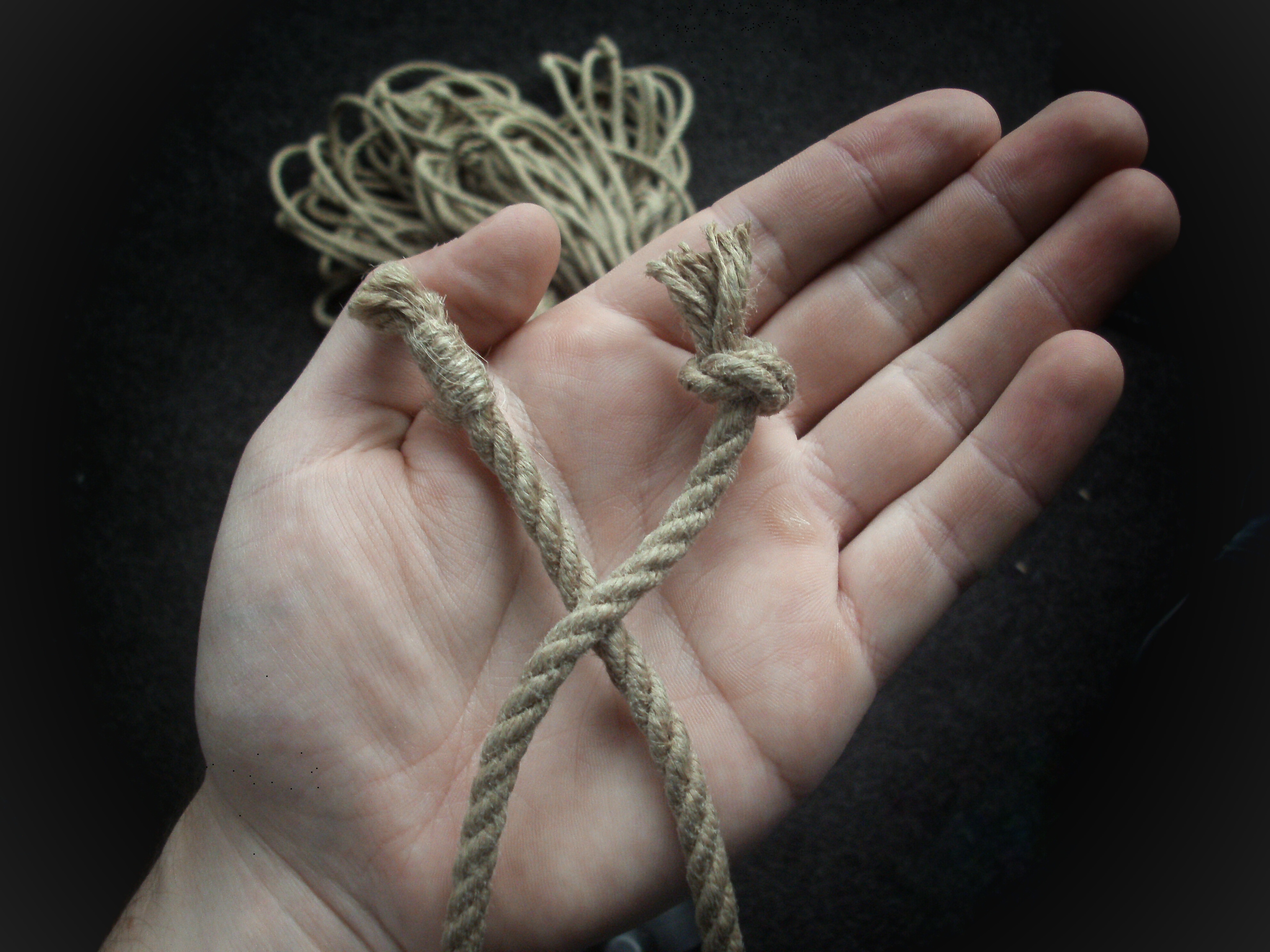
If you cut the ropes you bought into 8-meter lengths, the ends will fray and the rope will unravel. Therefore, you need to terminate the ends of the ropes. In our country, terminating ends by taping is often unsafe. So you should readjust the ends of your ropes. You can prevent this by tying blind knots, but you can also use other techniques.
Whipping End
What else should be included in your rope set?
One of the essential tools to have in your string kit is a string cutter for emergencies. This could be a bandage cutter or a cutter with a hook-shaped tip. It's important that the cutter offers maximum ergonomics and allows for the fastest possible cut. A regular pair of scissors or a knife is difficult to grip and doesn't provide an easy cut.
It is advisable to have sugary water or a similar drink available for use during your scenes, a flashlight or cell phone flashlight to illuminate the environment and scenes if necessary, and basic first aid supplies for cuts, scrapes, and injuries.
It's also important to have a sufficiently large cloth to place under your model in case you don't know when you'll need to use your string set.
 Türkçe
 English