USD
USD 
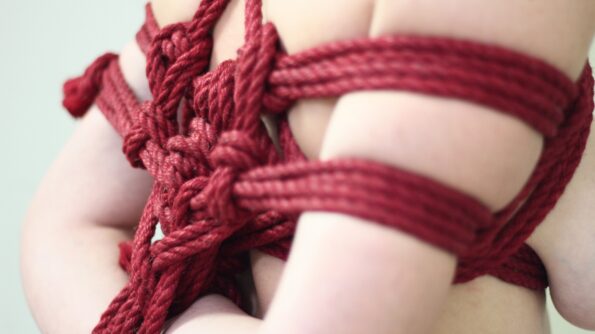
Gote Takatekote is one of the fundamental binding techniques in modern Japanese. It has several alternative names, including Takatekote (高手小手) and gote shibari (後手縛り). It also has multiple yomikata (reading) forms, such as: gote takatekote, takatekote, and ushirode takatekote.
Other Alternative Yomis
- Gote takategote
- ushirode takatekote
- ushirode takategote
- ushirote takatekote
- ushirote takategote
Alternative Names
- Box tie
- Chest harness
- Gote Shibari (後手縛り)
- Takatekote (高手小手)
- Ushiro takatekote (後高手小手)
- Ushiro takatekote (後ろ高手小手)
- ushiro takatekote Shibari (後高手小手縛り)
- Ushirote takatekote (後ろ手高手小手)
- Ushiro quoted Shibari (後小手縛り)
- Ushirode Shibari or ushirote shibari (後ろ手縛り)
- Gote munenawa Shibari (後手胸縄縛り)
- Kotetaka (小手高)
- Takakote (高小手)
- Takatekote Shibari (高手小手縛り)
"Gote" is used to indicate that the wrists are tied behind the back. "Takate" is an older word referring to the upper arm region. It can also be said that this word represents a posture where the arms are held in a high position. "Kote" means wrist.
Methods of Use
USAGE 1: This method involves joining the wrists behind the back, securing the rope to the upper arms and upper chest, and then wrapping it around the lower chest area with a second layer of wrap. The wrists should be relaxed and not tense, nor should they be in a high hand position.
USAGE 2: If the position is interpreted as a high hand position, the wrists should be as high as possible on the back of the hand. In this case, gote Shibari (or ushirote shibari) is used to represent a situation where the wrists are not in a high position.

USAGE 3: Most of the ancient hojojutsu Shibari For this, takate, kote, and neck are key locations to which the connection must be made. In this sense, it can be said that gote takatekote was also used in ancient usage (see, for example, Takashi Tsujimura's early work). The chest area (chest harness(It doesn't need to be tied.) However, it's unclear whether the term "gote takatekote" existed in ancient times (probably not). It may be a newer word that came into use between the 1950s and 1970s. The word "takatekote" is known to have been used in writing as early as 1923, but it's unclear whether it represents the hojojutsu style or the modern style. The modern style involves tying the chest area. Shibari It appeared in some art works and performances in 1888 (Meiji period). It is quite possible that they applied a modern style of takatekote to kabuki plays, which were quite popular at that time, but it is unclear what it was called and how it was named.
Overview of Takatekote Shibari
“Takate kote shibari” is a collective method for many types of tying. This technique is considered the core of modern Japanese tying art and also serves as a benchmark for a practitioner's skill level. The above names are commonly used for this tying technique. Tying with the hands clasped behind the back is called “ushirode shibari,” and tying with the hands clasped behind the back, encompassing both the upper and forearms, is called “ushirode takate kote shibari.” Some commentators believe this naming stems from the rope bottom being fixed behind the hands (ushirode: hands behind), and from both the forearms (kote: forearms) and upper arms (takate: upper arms) being tied together. However, there are also those who believe “takate” means pulling the forearms upwards.
In any case, takate kote Shibari This technique is most commonly referred to by its Japanese name. In the West, it's called a "box tie" because the arms are joined behind the back, forming a square shape. Recently, however, the simplified name "TK" has become the most common. Generally, a basic TK tie requires two pieces of rope. Therefore, some refer to it as a "2TK." Even when referring to the number of ropes used, the most common usage is "TK" because it's more practical. Shibari They have found a place in their surroundings.
Tracing the technique of the binding method, it is certain that it is derived from the form used in Japanese hojojutsu, as mentioned above. However, takate kote Shibari, It is not officially recorded as the name of a branch originating from any school or style of hojojutsu.

The takate kote shibari of contemporary kinbaku, revised by the Nawashi in modern times, differs significantly from traditional hojojutsu. Its main features include: hands clasped behind the back, forearms fixed parallel, and elbows bent at ninety degrees behind the back. It utilizes doubled ropes that wrap around the upper body parallel to each other; each rope loop is formed by wrapping the rope around two or more bodies.
Takate quote Shibari The design attempts to meet two principles: on the one hand, the tie must maintain the traditional hojojutsu appearance; on the other hand, the tie should not cause too much pain to the rope bottom during suspension. Traditional hojojutsu was conceived to prevent prisoners from escaping and was designed to make it uncomfortable. Therefore, takate kote Shibari It attempts to strike a balance between as many variables as possible. There is practical logic behind every step and detail.
Takate quote Shibari, This is the first major hurdle a kinbaku student will encounter. Beginners can quickly memorize the sequential steps of this binding and form a true binding. However, if you want to suspend it, you need to practice repeatedly to grasp the finer details of the technique. Many people, takate kote Shibari They believe that these practices (for everyone's safety) should be conducted one-on-one and face-to-face, guided by a supervisor or an experienced person.
It should not be overlooked that contemporary research indicates that many people point out that takate kote shibari is not the best way to suspend human body mechanics. However, due to its historical context and representative nature, this technique is Japanese. Shibari It has become the most important component of aesthetics. Takate kote Shibari A scene that lacks this would also be devoid of Japanese aesthetics.
Sources:
- http://smpedia.com
- https://bdsmkulturu.com
- Essence Of Shibari
 Türkçe
 English