USD
USD  (TRY ₺)

In terms of terminology, there are two different approaches to "bondage." One is what we call the Western style, or "fusion," and the other is the "traditional" or "Japanese" style. There are significant differences between these two, both in terms of the outcome and the process. This article will briefly discuss why we prefer "bondage" over "fusion." Shibari We will try to describe it using the words kinbaku or kinbaku, and write about the differences between these two.
WESTERN ROPE BONDAGE
Western-style rope bondage is usually done for sexual purposes. It's part of BDSM and essentially involves a structure that could be described as foreplay. Of course, the outcome is predetermined, and the process unfolds accordingly. BDSM As with many of its practices, rope restraint also involves a Western-style aesthetic. The purpose of this aesthetic doesn't go beyond the act of tying ropes for restraint. While the safety and risk profiles are the same, the fundamental difference lies in the materials used. The Western style uses ropes made of cotton, nylon, and similar synthetic fibers. These ropes generally have lower risk profiles and are made of materials that serve the purpose.
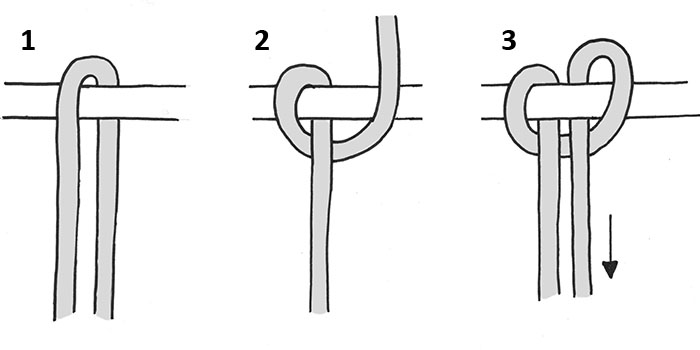
Western style often uses a dynamic knot, commonly referred to as a "larks' head." This knot is usually used to begin the binding, and at the end, all the ropes are joined at this point to finish with a square knot (camadan). This time-consuming method of binding, as mentioned above, stems from the fact that the act of rope restraint is viewed as a kind of foreplay. Instead of technically practical knots, these are used to focus on completely immobilizing the victim during sex role-playing.
One example, and a video from Two Knotty Boys, one of the best-known representatives of Fusion Bondage, will suffice to illustrate what we mean.Video 1: https://www.youtube.com/watch?v=taTF1frSooQ ).
In many Western-style rope bondage practices, it is used as a single line.Video 2: https://www.youtube.com/watch?v=01TWJZLyMHI) and usually the two ends are joined after tying. This does not mean it cannot be used folded.Video 3: https://www.youtube.com/watch?v=ZPe0hjflIAA )
Even with safety precautions, especially in restraint methods like the double column, there are risks in positions where the arms are extended.like arms tied behind the back) The pressure exerted on the blood vessels creates a risk of ligation.
JAPANESE STYLE TRADITIONAL BONDAGE
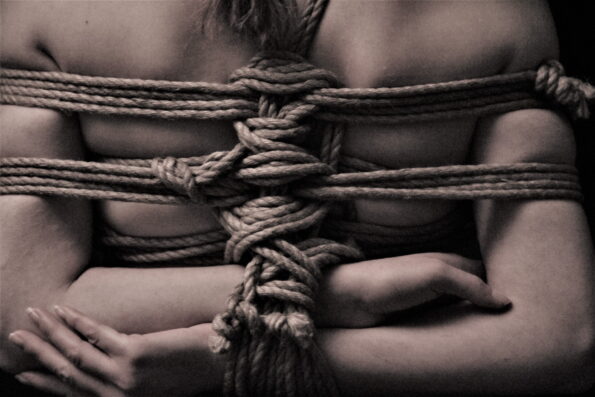
 We used the term "foreplay" for Western bondage. Traditional bondage, however, is lovemaking itself; it may not have any sexual purpose, it may be done purely for performance, or it may be used simply for relaxation. Natural fiber ropes called Asanawa are used, and the traditionally used rope type is jute. While its most distinctive feature is the rope used, unlike Western bondage, it doesn't employ mountaineering or scouting knots. It embraces the legacy of a centuries-old tradition: hojojutsu. Bonds don't begin with larks' head knots; they begin with a knot and always end with a knot. Intermediate bonds and transitions to other lines are supported by friction. Although the purpose is still bondage, it's not done by haphazardly wrapping ropes; it's considered safer and more aesthetically pleasing.
While ropes are folded in half and wrapped in a double layer and strip, kanuki is commonly used to secure ropes together, allowing for the creation of seemingly tight but comfortable knots like Takatekote (TK). The risk profile has been improved and developed over a historical process through experience, and perfectionist schools (ryu) have adopted different techniques.
In Japanese shibari, every tie carries a symbolic meaning. This is the most important feature that makes the Japanese style special and different from others. For example, Takete Tasuki-Gake, a technique developed by Grand Master Akeshi Denki and widely used today, is inspired by the fabric strips used to tie the sleeves of traditional Japanese kimonos. This is a small example showing how much Japanese life culture has influenced shibari and that every symbol added to shibari has a story.

 Türkçe
 English