USD
USD 
Whips have been a tool of punishment and control used for thousands of years. Generally long, flexible, and tapering to the end, whips are called lashes, while shorter ones, made by attaching leather or thongs to the end of a stick, are called whips. Whips and lashes are used for training or controlling animals, punishing people, self-harm for religious reasons, or for erotic purposes.(1)
A Brief History
Whips have existed in one form or another throughout recorded history. They appear in some reproductions of hieroglyphs (Egyptologists have previously found tablets with inscriptions such as "100 lashes and 5 whips").(2)Flagellation (from Latin flagellare: whipping) appears in tomb wall frescoes and paintings, on vases and mosaics, and sometimes in religious ceremonies. It was a form of purification used in ancient Egypt and Greece. Similar practices can still be seen in various cultures and countries.
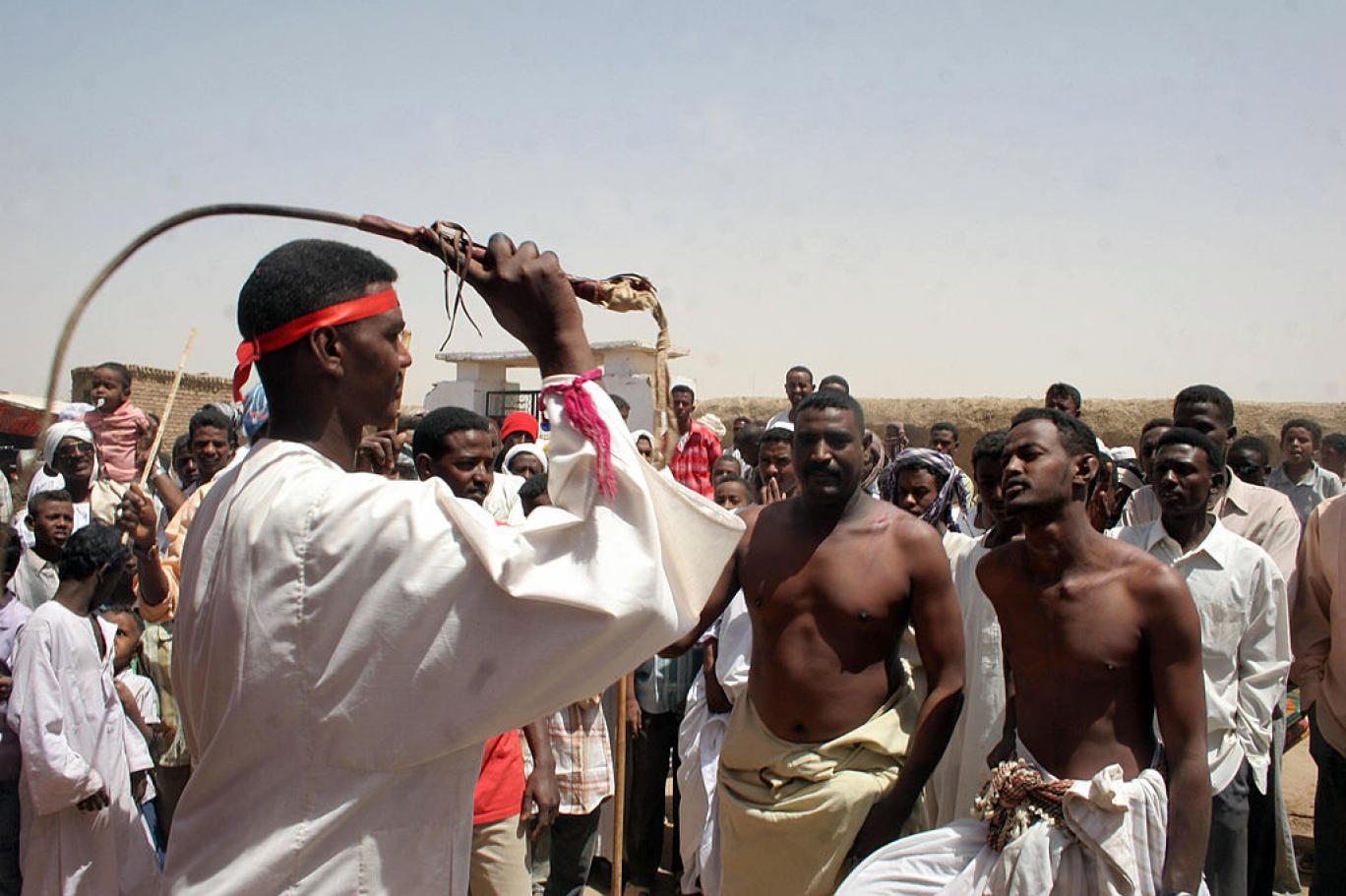
The purpose of using whips on animals (such as herds of cattle or horses) is to direct them by frightening them with sound. Today, the bull whip is generally used to control animals with the cracking sound rather than physical contact. It is the first known invention in the world to break the sound barrier.
How do we do it?
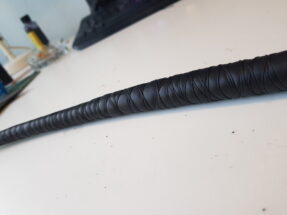
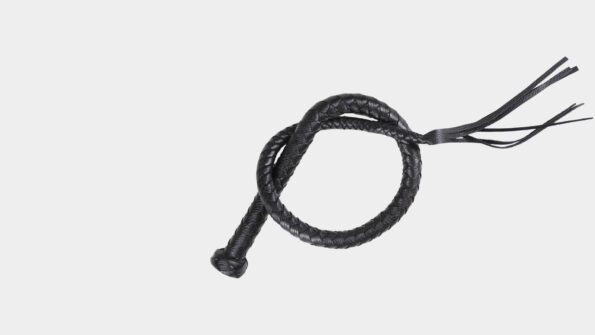
We generally make whips and lashes in lengths suitable for indoor use. These range in length from 80cm to 170cm, but we can also produce custom sizes upon request. We use first-class 1-1.2mm thick whips. Genuine Leather Our whips, which we make using [method name], are made in four layers.
- Core / Skeleton
- First covering mesh
- Cover
- Overlay / Final Coating
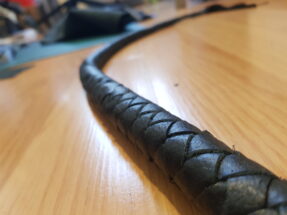
For whips of varying thicknesses, two additional layers can be added to achieve the desired thicker handle. For increased durability, each layer is wrapped with nylon cord or secured by gluing it to a lower layer. The braids can be made in 4, 6, 8, or 12 strips according to preference, and any desired colors can be used.
Anatomy
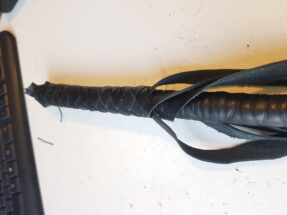
Thong / Braid / Body / (Thong) : The shaft of a whip is the entire leather braided section. It should be in the form of a straight cone and resistant to impact.
Butt Knot: This is a decorative part, usually finished with a turkshead knot. Depending on the whip, this knob can be made in various sizes to help distribute the whip's weight evenly. Often, this part is held in the palm of the hand by professional users during the downward stroke to perform controlled cracking.
Handle: The handle is the part of the whip, made of a rigid shaft, wood, or durable material, that allows the whip to be accelerated according to its length. While the handle is flexible in whips under 1 meter, it varies between 20cm and 30cm in whips over 1 meter, depending on the length of the whip.
Fall Hitch: This is where the body ends. For added durability, it is finished with a finishing knot sewn with waxed cord, and then a second finishing knot (whip knot) is made on top of that with leather.If this part is damaged, you will need to send the whip for repair. There is no repair fee for the products we make. You only need to pay the shipping cost.).
Tail (Fall): This part is made from thick cowhide. While impact-resistant, it will soften and deteriorate over time depending on use. If you notice it starting to soften, you can treat it with leather hardener or beeswax, or send it to us for replacement. Since this part can be made from different materials, you can also get support from us on how to replace it yourself.
Tail Braid (Popper): This part is the most susceptible to damage on your whip and is very easy to replace. While it's the only non-essential part of a whip, it's not necessary for a process like cracking. Source
- DilDernegi.org.tr.
- https://arkeofili.com/
- https://www.indyturk.com/
 Türkçe
 English